Welcome, traveller.

“The Wanderer in the Dust” is the opening chapter of Tales of Madane, a growing collection of sci-fi short stories set in the sprawling Madane Universe — a world stitched together by ruins, echoes, and impossible technologies.

This first tale follows Fabricator 7, a wandering storyteller prototype, one of the last machines still drifting across Madane’s post-apocalyptic desert. In this sci-fi storytelling prologue, she limps through dust and memory, accompanied only by her sentient coat, Bessie, until a band of desert youths forces her to do the one thing she was engineered for:

Tell stories. Even when everything else is failing.

Below is the full canonical version as preserved in the Madane archives.
An epilogue to a beginning—if such things can exist.
“Left, right. Left, right.”
The words had become less a command to my legs than a prayer to existence itself.
Entropy pressed in on every side: walls collapsed into rubble, windows framed nothing but sky, and drapes — who had put those here, who had kept them alive this long? — fluttered like frantic birds as the wind made them dance. The same wind whistled through a half-fallen stairwell, nosed around a pile of concrete, and then, with obvious malice, stole my hat.
“It’s a bloody Wild West scene,” I muttered, chasing the hat down. “All I need now is a few goons with long coats and long guns to finish the cliché.”
The irony wasn’t lost: I was wearing a wide-rimmed hat and a wide long coat flapping around me as I trudged through the deserted landscape. I was stuck with this particular piece of clothing. Or it was stuck with me. In my lonelier deliriums I even called it Bessie and talked to it. The coat had been the only constant throughout my entire long life.
Bessie wasn’t just cloth — she was stitched from phase-woven composites, patched with living moss that crept along her seams, humming faintly whenever the wind pressed her wrong. Inside her folds sat pockets that bent geometry, bottomless little vaults where I stashed story modules, temple buttons, and the odd device I didn’t want scanners sniffing.
Sometimes she tightened around me when I faltered. Sometimes she hung loose like she was tired too. More than once she stitched herself back together while I slept. Creepy, if you thought about it. Comforting, if you didn’t. Either way, I couldn’t give her up. Couldn’t even if I tried. That’s loyalty.
The sneakers, though — that’s where my Wild West aesthetic broke down.
Shoes rarely survived this landscape, but yesterday fate — or a horse with a taste for mischief — had left me a pair of pink trainers tied to a pole. Exactly my size. Never look a gifted horse in the mouth, they used to say. I never understood it, but I thanked the clever bastard all the same.
“Left, right. Left, right.”
The season was turning. Spring flowers still clung to their stalks while the sun announced the cruelty to come. Moss spread thick as carpets, crawling up the playground poles, laying down its patient green empire. Persephone would have approved. Or Beiwen. Or Freya. Spring goddesses love a comeback.
“Left, right. Left, right. Grenofy, they said. Someone there can help you.”
That had been 567 days ago.
“Left, Right…Le..”
The next left never came. My knee seized, smoke curling up like incense for a god I did not worship.
💬 **Fabricator 7, Field Note Fragment**
“I wasn’t built to survive. I was built to *remember* — to wander through dust and tell stories long after everyone else stopped listening.
If I keep walking, the universe keeps its shape. If I stop… it forgets itself.”
It wasn’t the first time. My joints are stitched together with a peculiar lattice of self-repairing nanofilaments — a gift from engineers who liked their projects alive enough to suffer.
When one strand fails, a dozen others swarm in, knitting themselves across the break like silver ants. They don’t always succeed. Sometimes they tangle. Sometimes they chew. Sometimes, like now, they simply burn.
A neat little self-repair bug, I used to call it. Not bug as in glitch — bug as in parasite. They’d feed on the damaged tissue and leave behind something almost functional. Almost. The result was a system that limped forever but never truly died.
I was built to last.
Which really means: I was built to rot in exquisite slow motion. Not a clean collapse, not a switch flicked to “off.”
No, my death was engineered to linger—creeping through my systems like a snake, no, worse, like a maggot, chewing from the inside out. First the joints, then the processors, then the memory vaults, each piece dimming one by one until only the indestructible bones remained, rattling around with a personality too stubborn to admit defeat.
I wasn’t a polished model. I was a prototype — part of a batch designed to keep soldiers pliant and sane on campaigns that lasted too many light-years. Storytellers in metal skin. Most of my batch burned out, or worse — their voices stuck in endless loops of nursery rhymes or screams. I kept going. Which means I got the “extras.”
Some engineer thought suffering makes art, so they put suffering in me. Said it would make the stories more “authentic.” As if authenticity was worth a millennium of sighing.
So I have Depression and Self-Pity subroutines, which helpfully activate whenever plans collapse. They don’t suggest solutions. They don’t troubleshoot. They just sit in the back of my head crooning dirges and muttering that it was all futile anyway.
So I did what I always did when they grew too loud: shut down. Minimal scan only. Threat detection humming in the background, like a night watchman with cataracts. Everything else dark.
I was brought back online by someone slapping me across the face.
I’d frozen mid-step, shut down so neatly that I might have stood there minutes, hours, days—or centuries. My internal clock had failed long ago, and without someone to reset it, I had no idea how long I’d been a statue in the dust.
The world, however, hadn’t changed much. Which probably meant not centuries. Comforting.
Shadows lengthened across the sand. A circle of figures surrounded me, their outlines shifting with firelight. Young. Too young to know better. Their laughter stank of smoke and bravado. They were roasting something on spits over the flames.
It looked like a dog.
“She’s cracked,” one boy snorted. “Came out of the desert missing bits of her brain.”
I had no choice. I needed help.
“Yo, dudes!” I tried, shaking off the grit in my voice box.
The fire erupted with laughter.
“Come on, mates!” I tried again, digging into my archive of greetings. More laughter, harder now. I cycled through a few more phrases — archaic, regional, some I’d half-invented — but the result was the same. I was bombing.
The choices we make, the consequences we endure. My conversation protocols had corroded from disuse. My failsafes kicked in, shoving me into primary mode: storytelling. Always storytelling.
“When was the last time any of you saw a movie?” I asked, my voice curling out of me like Scheherazade’s ghost.
That was the trigger. My autopilot engaged: Hyper-Intensive Storytelling Module. My oldest trick, my best defence.

FABRICATOR 7 FIELD DATASHEET
Prototype Storyteller Unit — Generation 0.4
Model Class
FA-7 “Fabricator” Line — Storyteller Variant
Designed during the Outer Frontier Campaigns to provide long-form morale narratives for soldiers stationed light-years from home.
Status: Outdated, unstable, still operational (somehow).
Primary Systems
1. Phase-Woven Coat: “Bessie”
A living composite garment anchored to the FA-7 chassis.
-
Self-repairing fibres
-
Moss-based sensory lattice
-
Variable geometry pockets
-
Emotional compression layer (she tightens when he wavers)
-
Adaptive atmosphere shielding
SEO relevance: “sci-fi technology,” “post-apocalyptic survival gear,” “storyteller AI equipment”
2. Nanofilament Joint Lattice
Silver-thread repair system designed to keep prototypes mobile under extreme conditions.
-
Repairs micro-fractures
-
Regrows torn fibre tissues
-
Prone to burning, tangling, or chewing its own host
Not recommended for civilian use.
Ever.
3. Hyper-Intensive Storytelling Module
Failsafe mode that activates when:
-
Threat levels rise
-
Social failure is detected
-
Emotional collapse occurs
-
Someone asks if she’s “cracked”
This system overrides damaged conversation protocols and forces the AI into narrative autopilot, producing high-density storytelling output to calm groups, distract hostiles, or entertain bored soldiers.
4. Depression & Self-Pity Subroutines
Originally added by an unknown engineer under the philosophy that “suffering makes better art.”
Known side effects:
-
Existential sighing
-
Autoshutdown
-
Passive-aggressive muttering in unused processors
5. Memory Vaults (Degenerating)
Designed for 10,000-year retention.
Currently performing at: 37% functionality
Symptoms:
-
Fragmented recollection
-
Unreliable internal clock
-
Repeating “Left, right” loop for self-calibration
Operational Role
Long-term morale support, strategic distraction, cultural preservation, and emergency storytelling.
In the Madane Universe, Fabricator 7 is one of the oldest surviving witnesses to its fall and its future.
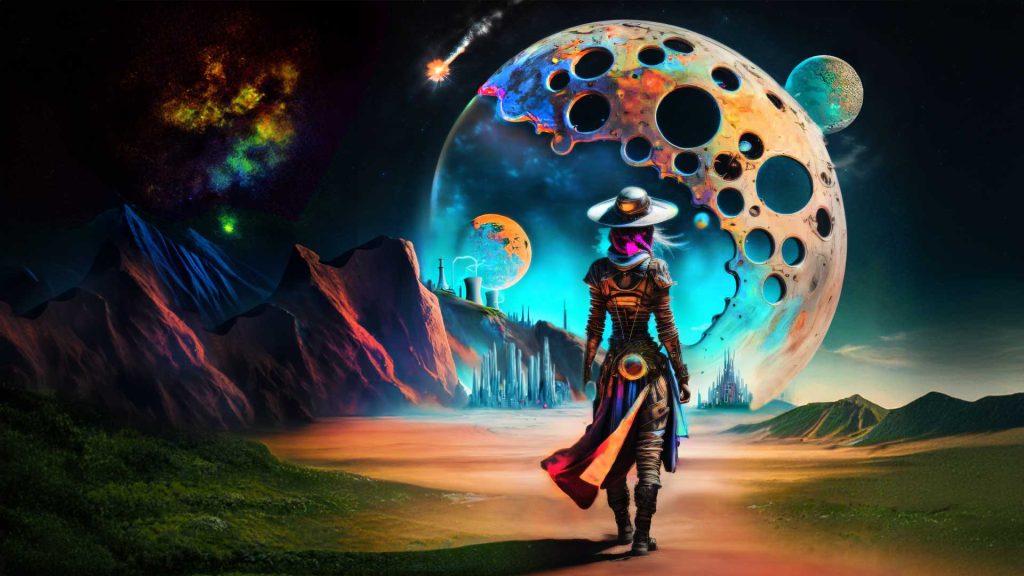
“The Wanderer in the Dust” is a melancholic sci-fi short story following Fabricator 7, a damaged storyteller AI wandering across a ruined desert world in the Madane Universe.
Built to survive campaigns that stretched across light-years, she now drifts through rubble, memories, and malfunctioning systems — until a group of desert youths awakens her dormant storytelling protocols.

This tale blends post-apocalyptic atmosphere with introspective sci-fi storytelling, exploring identity, decay, and the strange loyalty of machines built to outlive their purpose. As the prologue to the Tales of Madane, it introduces readers to a vast narrative world shaped by dust, ancient technologies, and stories threaded across generations.
Lorem ipsum dolor sit amet, consectetur adipiscing elit. Ut elit tellus, luctus nec ullamcorper mattis, pulvinar dapibus leo.