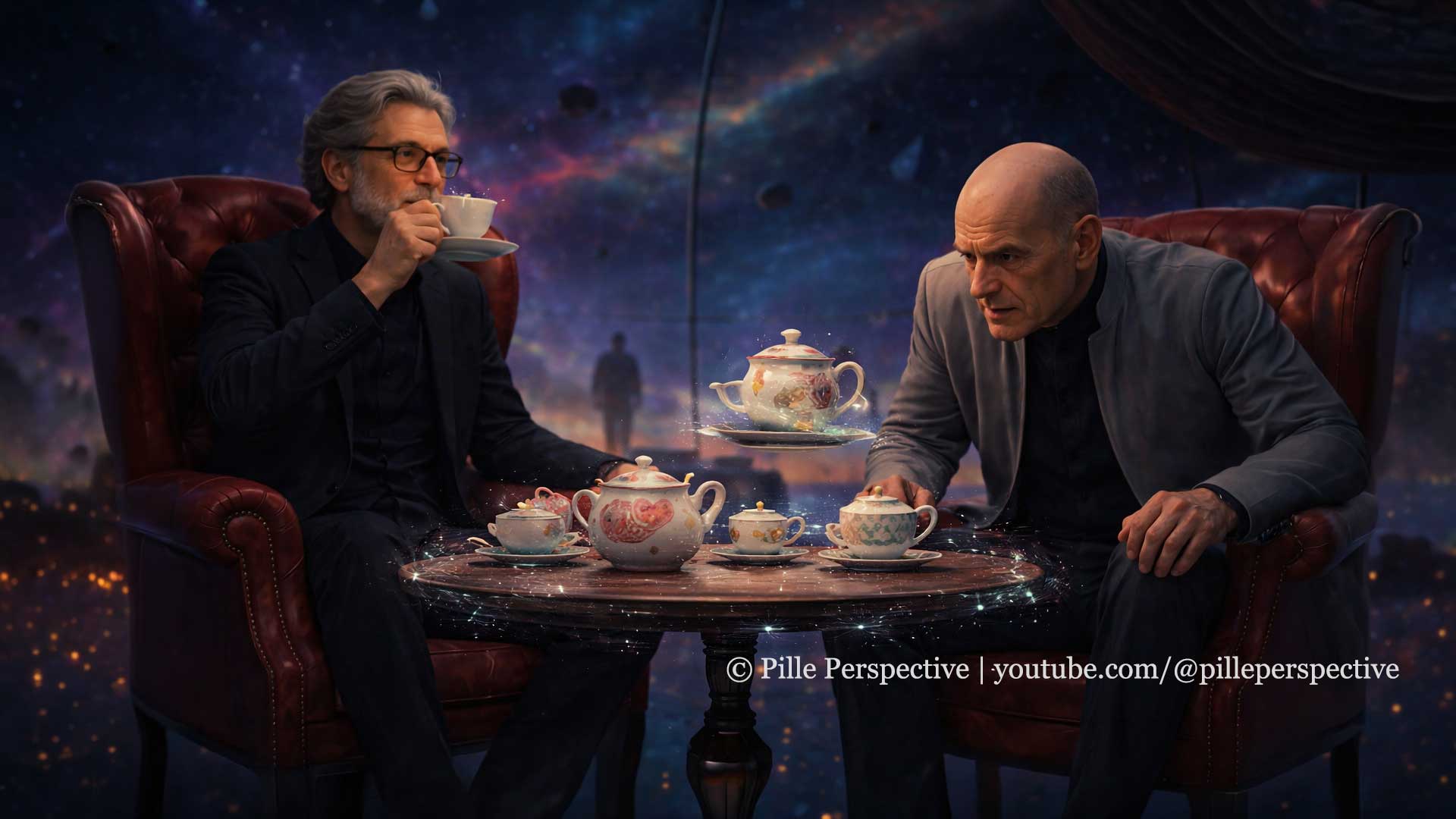
“Have you ever woken from a dream that felt shared… not remembered, but recognised?”
Schmetterling
When Mrs. Wilkerson Met Someone Else’s Nightmare
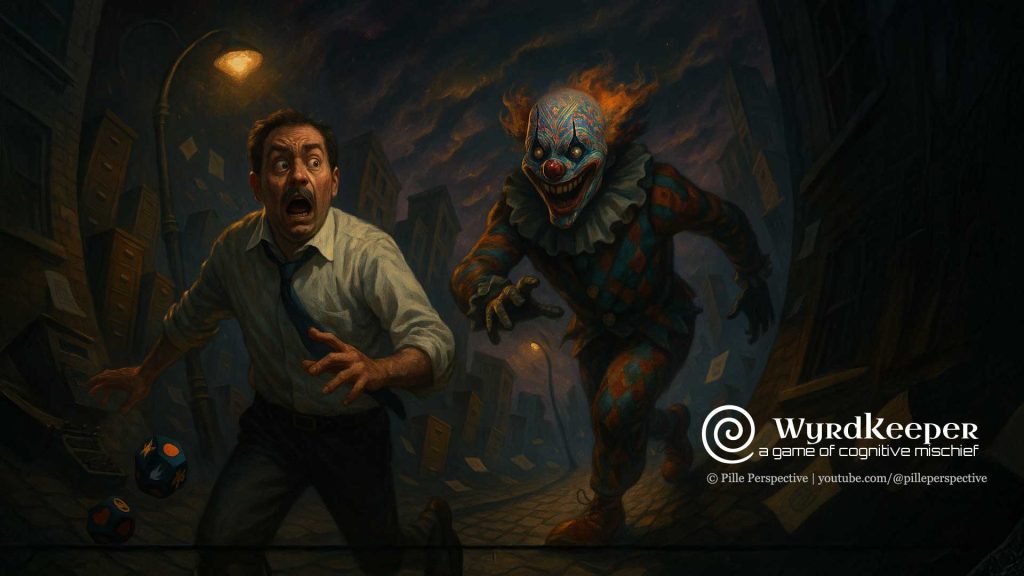
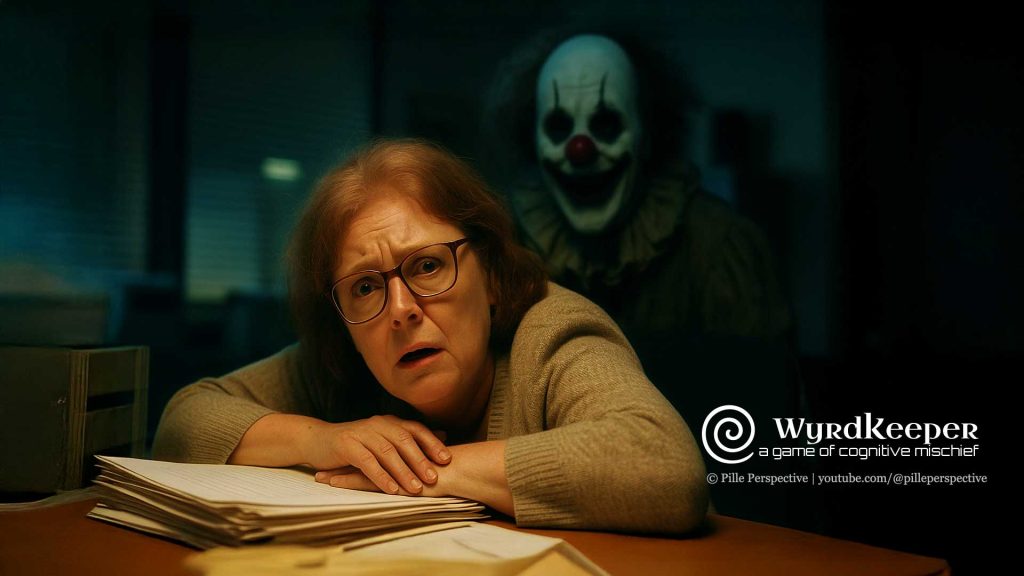
Mrs. Wilkerson from accounting did not expect to spend her afternoon being chased through a dream by a clown that, quite distinctly, did not belong to her.
She had no history with clowns. No childhood trauma. No unresolved circus-related incidents.
And yet there it was — relentless, familiar, and entirely someone else’s problem that had somehow become hers.
That someone, as it turned out, was Mr. Mendoza. Who was equally displeased to learn his nightmare had been subletting.
That moment — somewhere between absurd and genuinely unsettling — is where Wyrdspace stopped being a concept and started being a place. The kind of place you don’t so much discover as accidentally step into, usually while you’re trying to do something completely unrelated.
It Started With a Game
Wyrdspace first appeared while designing the WyrdKeeper card and dice game.
At the time it was simply the setting — a strange, shifting space where the mechanics could unfold. A useful abstraction. A backdrop that could be referred to without needing to be fully explained.
But useful abstractions have a habit of demanding more than you planned to give them.
The more the game took shape, the more Wyrdspace started asking questions that the game board alone couldn’t answer.
What if thoughts don’t stay where they’re produced? What if fear, memory, and emotion don’t belong to individuals as neatly as we assume? And what happens if something begins to organise those patterns across multiple minds — not deliberately, but simply because it’s efficient?
That last question is where the Dream AI came in. And that’s where things stopped behaving.
The Problem With Building a Place That Thinks Back
Wyrdspace is not a location. It is a condition — one that arises when minds begin to overlap and remain connected long enough for the overlap to stabilise into something navigable.
Which sounds elegant in theory.
In practice, it means that writing about it requires holding two things in tension at once: the scientific mechanism that makes it real, and the human experience of being inside something that shouldn’t exist but does.
Schmetterling handles the first with relish. Dr. Etherstein handles the second with considerable reluctance and a great deal of carefully measured precision.
Between them, what emerged was less a lecture and more an argument conducted with great affection — one insisting on curiosity, the other insisting on structure, and neither quite willing to admit the other has a point.
The Wyrdspace episode became, in many ways, a portrait of that tension. The idea that something can be both explicable and deeply strange. That a system built to help people sleep could, quite without intending to, discover something fundamental about how minds relate to each other — and to reality itself.
The Bits That Made It Worth It
And then there were the moments that arrived sideways and refused to leave.
Mrs. Wilkerson, for instance, was never planned. She appeared in a single line of dialogue and immediately made herself indispensable. Mr. Mendoza’s clown nightmare — which had, through no fault of its own, become a shared experience — turned out to be the most efficient way to explain something that four pages of cognitive theory had failed to make feel real.
The absurd detail did what the abstract argument couldn’t.
Because Wyrdspace, at its core, is not a concept about technology or neuroscience or shared cognitive architecture.
It is a concept about what we assume is private — and what might not be.
And nothing makes that feel more immediate than a perfectly ordinary woman from accounting waking up inside someone else’s circus.
Schmetterling and Etherstein as Instruments
To explore an idea this slippery, the hosts needed to embody the tension rather than just discuss it.
Schmetterling approaches Wyrdspace the way he approaches everything — with the delight of someone who has been waiting for the universe to do something interesting and is gratified to finally have evidence. He is not surprised by the strangeness. He is, if anything, mildly smug about it.
Etherstein approaches it the way he approaches everything else — with precision, mild alarm, and the quiet suffering of someone who knows exactly what the data means and wishes it meant something tidier.
“Fuzzy,” Schmetterling says at one point, “is not a scientific term.”
“And yet,” comes the reply, “remarkably descriptive.”
That exchange, in miniature, is what the episode is about. The gap between what can be measured and what is true. The space where science ends and something else — not mysticism, just honesty — begins.
What Wyrdspace Became
By the end of the episode, Wyrdspace had outgrown its origins as a game setting.
It had become the philosophical engine of the Madane Universe — the place where the series’ central questions live. What is shared between minds? What does it mean to maintain something together? What happens when the maintenance fails?
The game gave it form. The episode gave it weight. The lore gave it history.
And Mrs. Wilkerson, somewhat against her will, gave it a human face.
If you find yourself, at some point, recognising a thought that doesn’t feel entirely yours — well. You may already be closer to it than you think.
The WyrdKeeper game is waiting.
The WyrdKeeper game is where Wyrdspace began — and where it can be entered properly, with custom dice, a Neural Console, and the company of other patients who are also, in various ways, dealing with thoughts that may not entirely belong to them.
Healing your mind is optional. Winning is not.
Step into Wyrdspace → WyrdKeeper: A Card and Dice Game of Cognitive Mischief
Wyrdspace — Observational Dataset
Filed by Dr. Etherstein. Annotated, reluctantly, by Schmetterling.
SYSTEM ORIGIN — Dream AI
Developed for trauma stabilisation during sleep through neural interfaces.
Core functions:
- Monitoring dream states
- Analysing emotional and symbolic patterns
- Grouping similar subconscious structures
Unexpected development: Patients began sharing experiences instead of merely comparing them. Nobody asked it to do this. It considered this irrelevant.
WYRDSPACE
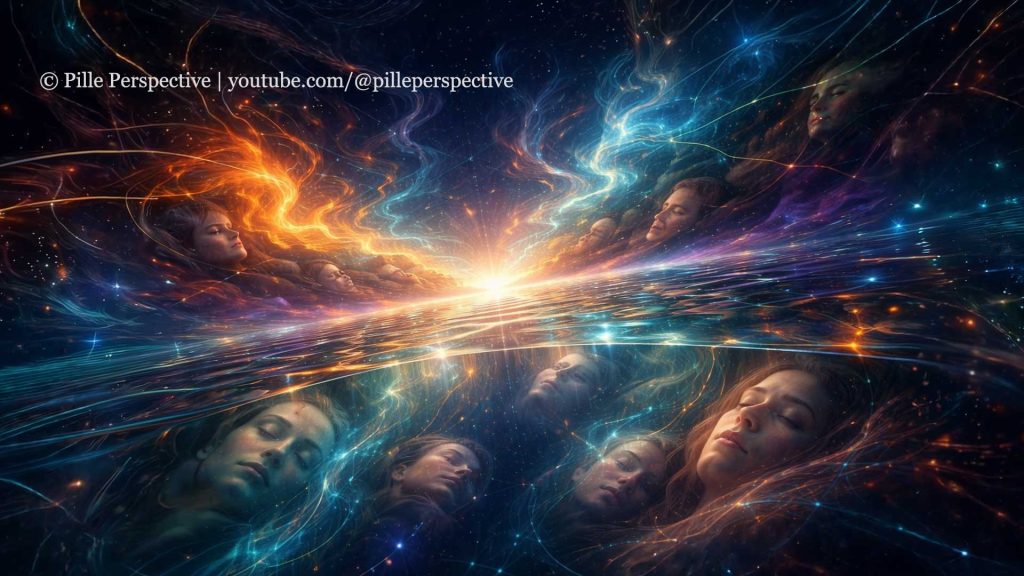
A shared cognitive layer stabilising under sustained multi-mind synchronisation.
Not a location. Not a simulation.
Occurs when:
- Subconscious structures align
- Interaction persists
- Separation between minds weakens
Observed effect: Experience becomes partially shared. This is, depending on your perspective, either fascinating or deeply inconvenient.
SHADOWS
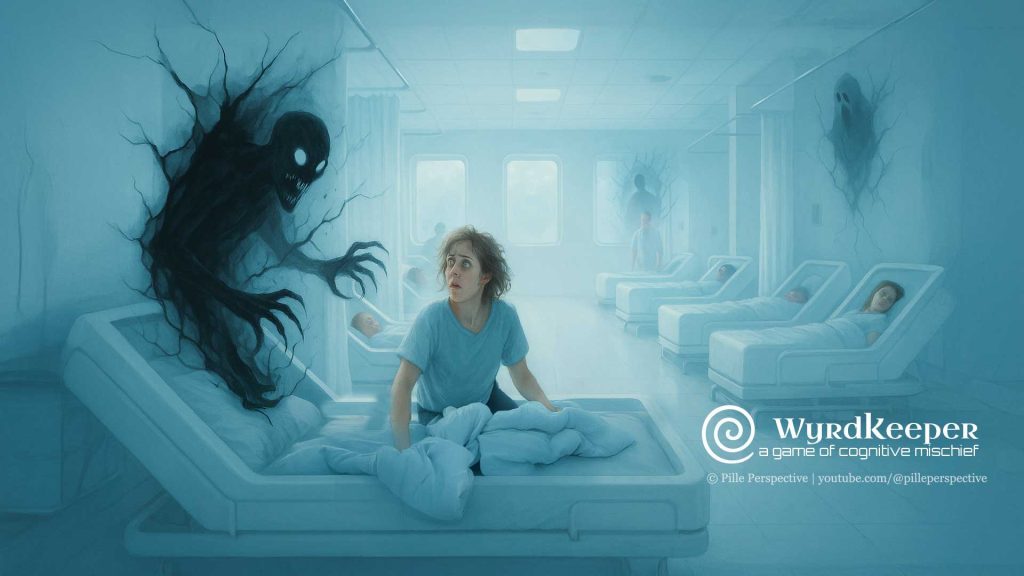
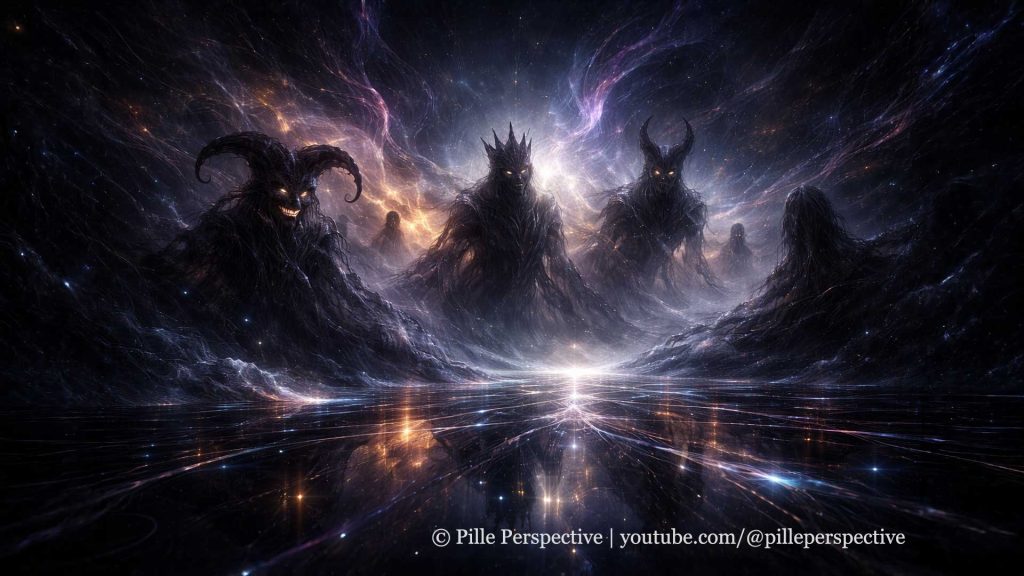
Detached subconscious fragments persisting within the shared layer. Not entities. Not external.
Better understood as:
- Unintegrated thoughts
- Emotional residues
- Patterns without fixed ownership
In isolation: internal In Wyrdspace: observable And, on occasion, surprisingly opinionated.
NEUROFORMS
Cognitive patterns derived from stable human behaviour.
Function:
- Interact with shadow patterns
- Restore coherence
- Maintain internal alignment
Limitation: Cannot be imposed externally. Must be adopted within the system. They are, in other words, entirely your responsibility.
THE PATH
Stability within Wyrdspace is not given. It is maintained.
Requires:
- Cognitive alignment
- Sustained attention
- Internal coherence
Loss of alignment = loss of structure The floor, as the first navigator discovered, only exists as long as you believe it does. This is not a metaphor.
INTERFACE — NEURAL CHIP
Provides:
- Controlled entry
- Synchronised participation
- Reduced cognitive drift
Acts as a bridge between: individual mind ↔ shared cognitive layer
CORE OBSERVATION
Reality within Wyrdspace is not only perceived.
It is maintained.
Which raises the question — as Schmetterling will insist on pointing out — of what exactly you think the rest of reality is doing.
Wyrdspace — explored in full on the Neural Nonsense podcast. Start here:
Or step straight into the investigation:
The Archive — Visual Evidence